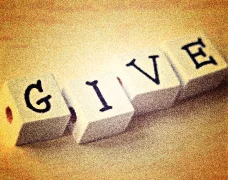
Open your heart and give often.
Generosity is giving to others, whether prompted or not. Those who are generous will reach out unsolicited to those around them, lightening their load and brightening their days. Generosity imbalance, however, can appear in two ways. On one hand, being overly generous can bring one’s finances to ruin, while not being generous at all leads to miserliness and greed. A properly displayed trait of generosity knows when to give and how to give, and with the right spirit.

Meditation
The Hebrew phrase for generosity is nedivut, which also means magnanimity. This helps us understand that Nedivut is so much more than giving someone money or material items. It also means giving of our time, energy and second chances.
Daily Questions
What were the seeds that started to erode your generosity today?
Think of how you used the resources around you today (money, natural, etc..). Did you see a need and respond generously? Why or why not?
Were you generous in your speech today? Did you take a moment to say something positive to someone to lift him/her up?
Is there a plan today or one day this week to distribute charity?
Did you look at someone today and judge their neediness or did you help them? Is this a different response than you usually give?
Does giving make you feel superior or haughty?
Is it difficult for you to give of your possessions to help others?
Featured Articles
Travel always provides lots of opportunities for practicing the middot—standing in a TSA security line is ideal for developing patience; staying strapped into a narrow seat on a crowded plane is perfect for equanimity; and there are boundless opportunities for humility. On my latest trip I had a chance to learn about the middah of generosity.
When people think of generosity, they usually think of gift giving, especially during the winter holidays. The focus is on what you give and what you get.
The Sages interpret the unusual Hebrew word me’odecha in the Shema (Deut. 6:5), translated "might" above, to mean “substance,” “resources,” or even “wealth”—which gives us a perfect text for the middah of generosity. We express our whole-hearted love for Hashem by practicing generosity toward others.
In Devarim 15:7, it begins with "be warm-hearted and openhanded to our brethren." From this, our people have had a longstanding tradition and connection in the giving of tzedakah. The Torah admonishes us to give whatever is lacking to the person in need and give wholeheartedly.
The act of giving is a relatively simple thing. When you give you are simply transferring something that was once yours to someone else. It is entirely possible to give angrily, happily, begrudgingly, indifferently, or thoughtfully. Generosity, on the other hand is a different matter. Generosity has a component of mindfulness and “heartfulness” that goes beyond the physical act of giving.
One of my favorite jokes is a story of a group of scientists who, convinced that they don’t need God anymore, proceed to attempt to prove it by making a human being out of the dirt (like he made the first). They do quite well and God decides to let them know how nice of a job they did but, to be fair, if they really wanted to prove they didn’t need him anymore they should get their own dirt!
Travel always provides lots of opportunities for practicing the middot—standing in a TSA security line is ideal for developing patience; staying strapped into a narrow seat on a crowded plane is perfect for equanimity; and there are boundless opportunities for humility. On my latest trip I had a chance to learn about the middah of generosity.
I am increasingly aware that time is one of the most valuable things in my life. There is so much to do and so little time, as the saying goes. My chevruta and I have often discussed the role of time in the middah of generosity.
When people think of generosity, they usually think of gift giving, especially during the winter holidays. The focus is on what you give and what you get.
The Sages interpret the unusual Hebrew word me’odecha in the Shema (Deut. 6:5), translated "might" above, to mean “substance,” “resources,” or even “wealth”—which gives us a perfect text for the middah of generosity. We express our whole-hearted love for Hashem by practicing generosity toward others.
Our society has a somewhat dysfunctional approach towards generosity at this time of year. By and large the expectation is that if you receive a “holiday” gift from another, you’re obligated to reciprocate.
Similar is generosity, which is the middle between stinginess and wasteful extravagance.
While we try hard to give to those who really need it, we try not to turn anyone away. Feeding people means having an attitude of generosity towards the people we help. I encourage everyone, in their giving, to be as generous as they can be. It helps others, and is good for your soul.
In his vow, Jacob is acknowledging the true origin of all things. Everything we have is on loan to us. It is an illusion to think that whatever prosperity we attain is solely because of our own efforts.
In Devarim 15:7, it begins with "be warm-hearted and openhanded to our brethren." From this, our people have had a longstanding tradition and connection in the giving of tzedakah. The Torah admonishes us to give whatever is lacking to the person in need and give wholeheartedly.
The words of Yaakov against the rich of his day are powerful and condemning. What is critical to understand is that it is not just the fact that the rich have so much, it is that what they have is at the expense of others. They stored up the payment for their workers for themselves instead.
Once a very rich man, Yossele, was considered a stingy, mean miser. Everyone was sure that he shared his wealth with no one, never gave to anyone – ever. Everyone in the ghetto where he lived knew how much he had and how he hoarded it, and everyone judged him for not doing something to help the suffering and need of the women and children and the elderly. But he never made public donations...
Quotables
"Therefore, a man should take care to be generous according to his means, to be magnanimous where magnanimity is called for…weighing all in the scales of Torah." -- The Ways of the Tzaddikim, The Gate of Miserliness, page 323
"People curse the one who hoards grain, but they pray God's blessing on the one who is willing to sell." -- Mishlei 11:26
"Give, and it will be given to you; they will return to your lap a beautiful measure pressed, crammed full and overflowing. For with the measure that you use to measure, it will be measured to you."-- Mashiach Yeshua, Luke 6:38, DHE
"He who wants to give and also that others should give—he is a saintly man." -- Avot 5:16
"Whosoever possesses these three qualities belongs to the disciples of Abraham our father: a generous eye, a humble spirit, and a meek soul." -- Avot 5:22
"One person gives freely, yet gains even more; another withholds unduly, but comes to poverty." -- Mishlei 11:24
"It is more blessed to give than to receive." -- Acts 20:35
"If one is measuring out wine, oil or the like, he must not be over-exact, but give a little more." -- Bava Basra 88b
"The ideal is to give correctly to a deserving poor person, with a pleasant expression." -- The Ways of the Tzaddikim, the Gate of Magnanimity, page 313
"For in the place where your treasure is, there your heart will be also." -- Mashiach Yeshua, Matthew 6:21, DHE

In his vow, Jacob is acknowledging the true origin of all things. Everything we have is on loan to us. It is an illusion to think that whatever prosperity we attain is solely because of our own efforts.